
What happens when the same message is spoken in two languages, but the experience of hearing it feels entirely different?
Seelenflüstern. Herzensraum. Schöpferkraft. Seelenfrieden. Wahrhaftigkeit. Seelenheil.
Six German words. Six different emotional landscapes.
And six beautiful reminders of why I once felt compelled to record my Soul Health Mentor Podcast in both English and German.
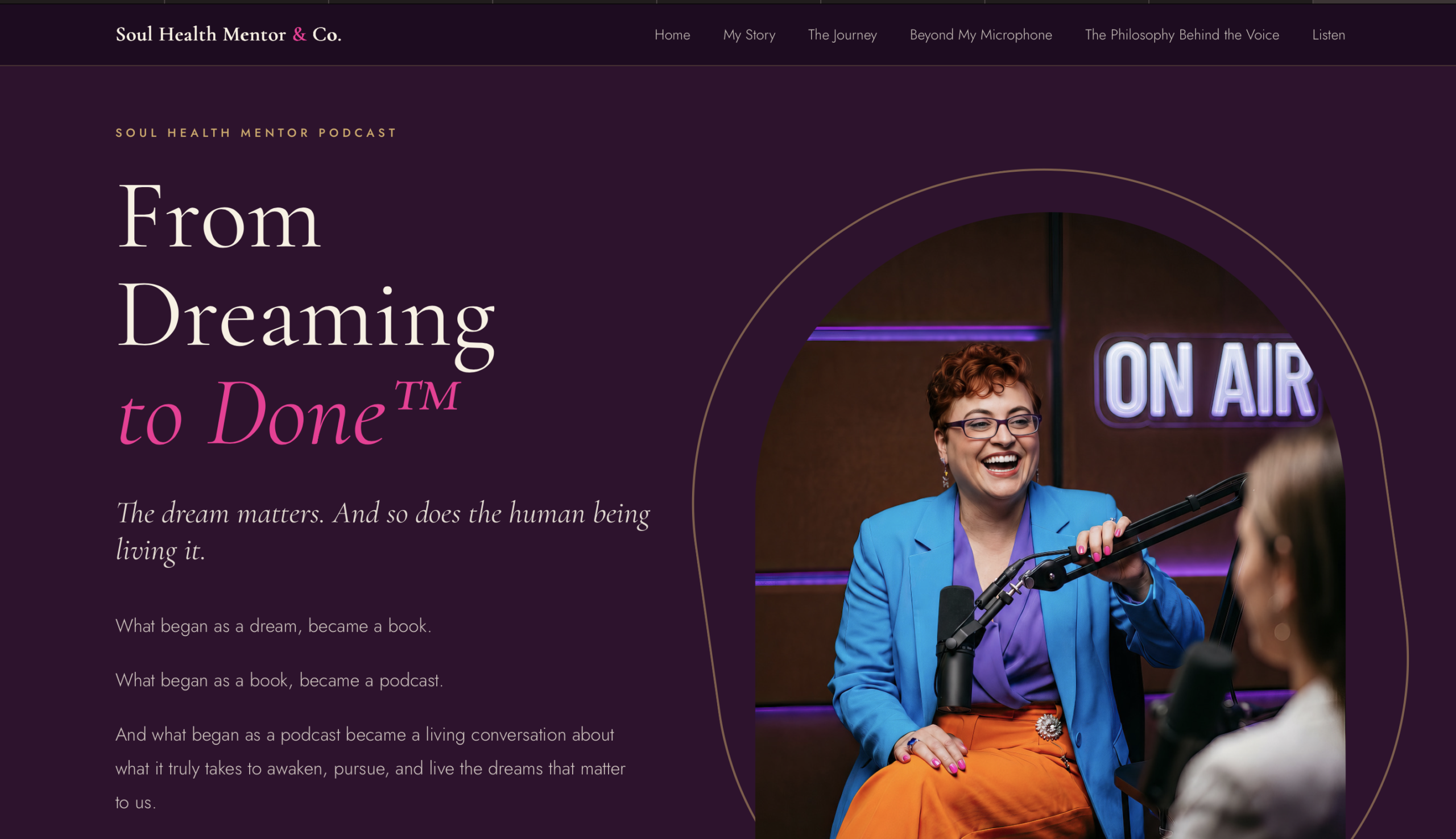
Recently, I created a curated Soul Health Mentor Podcast Experience, bringing together 28 episodes from my body of work into a listening journey through three developmental chapters of From Dreaming to Done™: Awakening, Identity, and Relational Sovereignty.
Then I decided to do something a little unusual.
For 28 days, I’m taking one of my own podcast episodes with me on my daily walk. Not to review my work, but to experience it as a listener.
And when I listened to one of my German episodes, something happened.
I felt like I had come home.
Not because the message was different from its English counterpart. But because the words themselves carried something I had missed.
Why I Needed to Speak in Two Languages
When I originally began recording my podcast in English and German, it wasn’t simply about reaching two different audiences.
I had been living and working in English-speaking environments for years. And although I could communicate my ideas, share my experiences, and express my philosophy in English, something felt incomplete.
It was almost as though half of my voice had been amputated.
Recording in German became a way of reclaiming that missing part of myself.
Because German allows me to express certain inner experiences through words that feel deeply familiar.
Words that don’t just describe something.
Words that evoke something.
And while English can certainly express these experiences, it doesn’t always carry them in quite the same way.
Let me show you what I mean.
Six German Words and the Worlds They Carry
1. Seelenflüstern — The Whisper of the Soul
Imagine an inner voice that doesn’t shout, demand, or compete for your attention.
It whispers.
Seele means soul. Flüstern means whispering.
Together, Seelenflüstern evokes that subtle inner knowing we sometimes recognize only when we become quiet enough to listen.
In English, the whispers of your soul comes close.
But in German, the experience lives inside a single word.
To a German ear, Seelenflüstern sounds tender, poetic, and distinctly spiritual. For some, it feels beautiful and intimate. For others, it may sound a little mystical or esoteric.
And that’s part of what makes language fascinating.
The same word can open a door for one person and feel unfamiliar to another.
A question to explore: When was the last time you became quiet enough to hear what your own inner voice was telling you?
2. Herzensraum — Making Room for the Heart
Herz means heart. Raum means space or room.
But Herzensraum is more than simply heart space.
It suggests an inner place where feelings, experiences, and truths are allowed to exist without immediately needing to be explained, corrected, or fixed.
It can also describe the atmosphere we create for another human being.
A space where someone can simply be.
In German, the word feels warm, intimate, and nurturing. You’ll often encounter it in mindfulness, coaching, and spiritual communities, although it isn’t a conventional everyday expression.
And here’s what I love about it:
Sometimes the most meaningful thing we can offer ourselves isn’t another solution.
It’s room.
Room to feel. Room to breathe. Room to become.
A question to explore: How much Herzensraum are you giving yourself in the life you’re creating?
3. Schöpferkraft — The Power to Bring Something Into Being
Now this is a word I absolutely love!
Schöpferkraft.
It’s often translated as creative power, but that doesn’t quite capture its full scope.
Schöpfer means creator, and Kraft means power or strength.
Schöpferkraft speaks to our capacity to imagine, create, and bring something into existence that wasn’t there before.
Not only through artistic expression, but through the choices we make, the actions we take, and the lives we shape.
It carries imagination, agency, responsibility, and authorship.
In German, the word can sound philosophical, powerful, artistic, or spiritually charged, depending on its context.
For me, it connects beautifully to the heart of From Dreaming to Done™.
Because dreaming is one thing.
Allowing yourself to become the creator of what you’ve dreamed is another.
A question to explore: Where in your life are you ready to move from imagining what’s possible to actively creating it?
4. Seelenfrieden — Peace That Reaches Deeper
Seele means soul. Frieden means peace.
But Seelenfrieden isn’t simply having a peaceful afternoon or feeling relaxed.
It suggests something deeper.
An inner struggle has softened. Something unresolved has found a place to settle. There is less need to fight against yourself, your past, or the life you’ve lived.
English offers peace of mind and inner peace.
Both are meaningful expressions.
But Seelenfrieden carries a particular emotional weight.
Unlike some of the more poetic words in this collection, Seelenfrieden is familiar and established in German. It can be understood well beyond spiritual communities.
It speaks of reconciliation, acceptance, and a profound sense of inner peace.
And perhaps that’s something worth remembering in our busy lives.
Not every dream asks us to achieve more. Some invite us to make peace with ourselves.
A question to explore: What might become possible if you no longer had to fight yourself to move forward?
5. Wahrhaftigkeit — The Courage to Live Truthfully
This word has an entirely different energy.
Wahrhaftigkeit.
It is related to Wahrheit, meaning truth.
But Wahrhaftigkeit isn’t merely about knowing the truth or stating correct facts.
It speaks to truthfulness, sincerity, integrity, and the willingness to live in alignment with what we know to be true.
English words such as authenticity and truthfulness capture important parts of its meaning.
But Wahrhaftigkeit can feel more demanding.
It’s not simply about expressing your personality or being yourself.
It’s about being deeply truthful with yourself.
In German, the word carries philosophical and moral seriousness. It belongs as comfortably in literature, ethics, and psychology as it does in a meaningful personal conversation.
And I find the relationship between Seelenflüstern and Wahrhaftigkeit especially beautiful.
One invites you to hear your inner voice.
The other asks:
Will you have the courage to live according to what you hear?
A question to explore: Is there something you already know to be true about your life that you’re finally ready to honor?
6. Seelenheil — The Well-Being of the Soul
And then there’s Seelenheil.
Perhaps the most historically and spiritually charged word in this collection.
Seele means soul. Heil carries meanings connected to wholeness, salvation, and well-being.
Seelenheil has deep roots in Christian and theological language. It concerns something beyond everyday emotional comfort: the ultimate welfare of the soul.
To a German ear, it can sound solemn, traditional, religious, or even old-fashioned.
It’s not simply another fashionable wellness expression.
And that’s precisely why it carries such weight.
It asks us to consider the well-being of the human being at a level deeper than achievement, productivity, or outward success.
For me, it resonates with a question that runs through my entire body of work:
What happens to the human being while they’re busy building the life they’ve dreamed of?
Because what good is a completed dream if we’ve abandoned ourselves along the way?
A question to explore: What does caring for your own soul actually look like in everyday life?
One Message. Two Languages. Two Different Experiences.
Here’s what I find extraordinary.
These six German words don’t all belong to the same emotional world.
Some are tender and mystical.
Some are philosophical and demanding.
Some feel warm and nurturing.
Others carry centuries of spiritual and cultural history.
And yet, together, they create a beautiful conversation about what it means to be human.
Seelenflüstern invites us to listen.
Herzensraum gives us room to feel.
Wahrhaftigkeit asks us to live truthfully.
Schöpferkraft reminds us that we can create.
Seelenfrieden speaks of inner reconciliation.
And Seelenheil asks us to consider the deeper well-being of our soul.
This is what I mean when I say that German can sometimes carry an entire inner experience inside a single word.
Of course, English has its own beauty, richness, and emotional possibilities.
But translating a word doesn’t always reproduce the experience of hearing it.
Sometimes the dictionary preserves the meaning, but not the emotional architecture of the word.
And that’s what I rediscovered while listening to my own German podcast.
The Joy of Rediscovering My Own Voice
Eventually, I stopped producing my podcast in both languages.
Creating every episode twice was simply a lot of work.
But listening to those German recordings again has reminded me why I created them in the first place.
I wasn’t trying to say more.
I was giving myself permission to express more of who I am.
And now, years later, I get to experience those conversations again — not only as their creator, but as a listener.
There’s something wonderfully unexpected about receiving wisdom from something you once created for others.
It reminds me of a phrase I love:
Soul Health Care is a work of heArt. Your heart!
And sometimes caring for ourselves begins with something as simple as listening.
Come Along for the Listening Journey 🎧
I’ve created a curated Soul Health Mentor Podcast Experience featuring 28 episodes — 21 in English and seven in German — organized around three developmental chapters of the From Dreaming to Done™ journey.
Awakening: Hearing the call of your dream.
Identity: Becoming the person who can live it.
Relational Sovereignty: Learning to live your dream without abandoning yourself.
For 28 days, I’m listening to one episode during my morning or evening walk and sharing what I discover along the way.
And I’d love for you to join me.
You don’t have to listen in a particular order or keep up with my schedule.
Take a walk. Make yourself a coffee. Find a quiet moment.
Press play and see what speaks to you.
And if you understand both English and German, you have the opportunity to experience some of these conversations in two languages.
Same heart. Same message. Different emotional landscapes.
Perhaps you’ll discover something about your own voice along the way.
The dream matters. And so does the human being living it. ❤️
🎧 Explore the curated Soul Health Mentor Podcast Experience
Leave a Reply
You must be logged in to post a comment.